The reason why airports feel different comes down to the way they compress so many emotional experiences into a single location at once.
Airports have a strangely unique atmosphere. They are crowded yet emotionally isolating, stressful yet exciting, highly structured yet emotionally surreal. Time feels unusual inside them. Conversations sound temporary. Ordinary social rules seem slightly suspended.
Most people immediately recognize the emotional sensation of being in an airport, even if they struggle to explain exactly why it feels so distinct from everyday environments.
Airports create this atmosphere because they combine anticipation, uncertainty, movement, security, anonymity, and emotional transition all within carefully designed architectural spaces. They are environments built almost entirely around temporary human states: departure, arrival, waiting, separation, and possibility.
Airports Exist Between Destinations
One reason airports feel psychologically unusual is that they function as transitional spaces.
People are not fully “here,” but they are not yet “there” either. Airports exist between locations, routines, identities, and schedules.
Psychologists sometimes describe these types of environments as liminal spaces, places associated with transition rather than permanence.
This creates emotional ambiguity.
Inside airports, people temporarily detach from normal routines, responsibilities, and local environments while mentally orienting toward somewhere else entirely. Daily life feels partially suspended.
The atmosphere becomes emotionally strange because almost everyone inside the space is psychologically focused on movement rather than settlement.
Airports are environments built around temporary existence.
Read The Growing Appeal of ‘Slow Living’ for more on changing modern routines.
Anticipation Shapes Emotional Atmosphere
Airports are filled with anticipation.
Some travelers are excited about vacations, reunions, opportunities, or adventures. Others feel anxious about delays, flying, separation, work trips, or unfamiliar destinations.
This emotional mixture creates a distinctive psychological energy.
Unlike ordinary public spaces, where people often share similar purposes, airports bring together individuals experiencing radically different emotional states.
Joy, grief, nervousness, exhaustion, hope, loneliness, and excitement coexist constantly within the same environment.
The brain subconsciously absorbs this emotional tension, which contributes to the feeling that airports carry an unusually intense atmosphere compared to most everyday locations.
Time Feels Different Inside Airports
Many people notice that time feels strangely distorted while traveling through airports.
Part of this comes from uncertainty and waiting. Delays, boarding schedules, security lines, gate changes, and layovers disrupt normal time perception by making attention hyper-focused on clocks and timing.
At the same time, airports operate on rigid systems where every movement depends on schedules, procedures, and sequencing.
This combination creates psychological tension between urgency and passivity.
Travelers often rush intensely through terminals only to sit waiting for long periods afterward. The brain repeatedly shifts between stress and inactivity, which distorts how time feels emotionally.
Airports also disconnect people from ordinary daily markers. Different time zones, irregular sleep schedules, artificial lighting, and unfamiliar surroundings further contribute to temporal disorientation.
Explore Why Time Feels Faster as You Get Older for another look at time perception.
Airports Blend Anonymity With Shared Experience
Airports create unusual social environments because strangers share intense temporary experiences without expecting lasting interaction.
People sit beside each other for hours while knowing almost nothing about one another. Travelers overhear conversations, observe emotional reunions, witness stressful situations, and move collectively through tightly controlled systems.
Despite this closeness, airports remain highly anonymous spaces.
Most interactions feel brief and transactional. Individuals pass through one another’s lives momentarily before disappearing completely.
This combination of emotional proximity and social distance creates an atmosphere unlike that of most public environments.
Airports feel simultaneously crowded and isolating.
See Why Humans Are Naturally Curious About Other People for more on social observation.
Security and Surveillance Affect Behavior
Modern airports also feel psychologically distinct because security systems constantly influence movement and behavior.
Travelers surrender personal items, follow highly controlled procedures, pass through checkpoints, and remain aware of surveillance throughout the experience.
This creates low-level tension even during routine travel.
People become unusually conscious of rules, timing, documentation, and social behavior in airports because the consequences of mistakes feel more significant than in many other environments.
At the same time, travelers often experience temporary emotional vulnerability due to fatigue, unfamiliarity, or travel stress.
The combination of surveillance and vulnerability contributes to the heightened emotional atmosphere many people associate with airports.
Architecture Shapes the Feeling Too
Airport design strongly influences emotional perception.
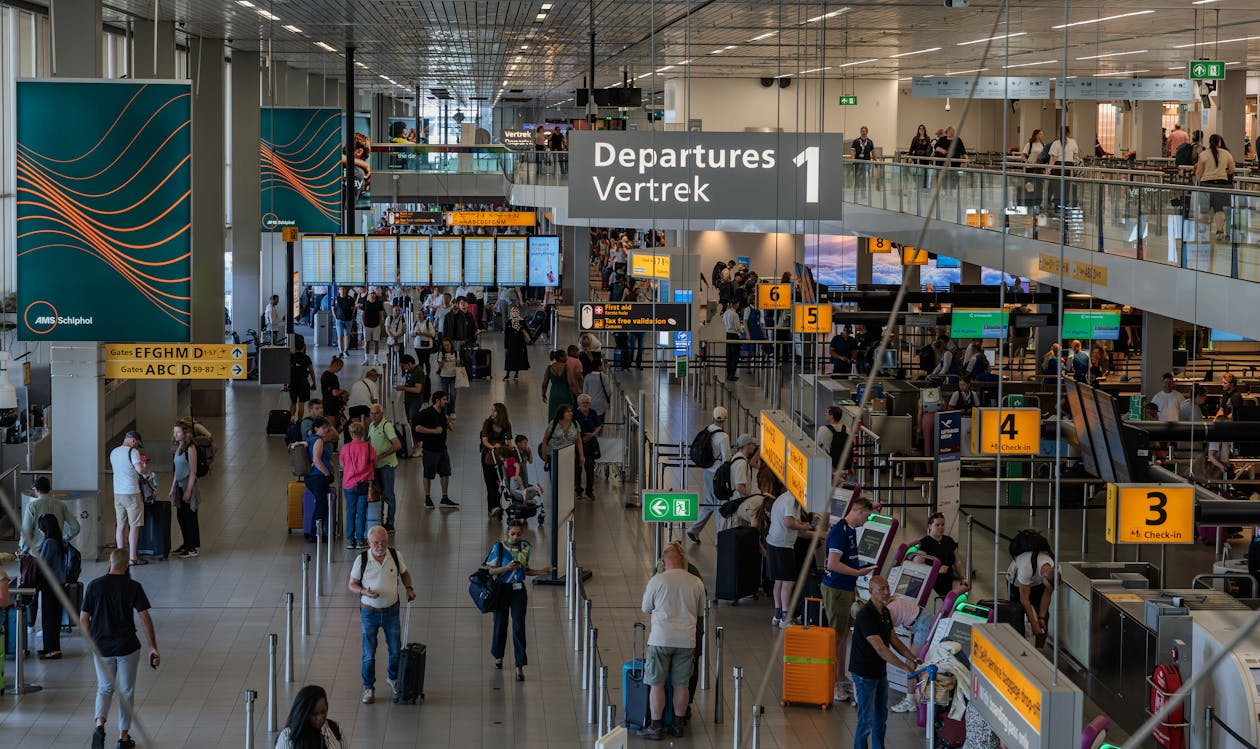
Large open terminals, massive windows, bright artificial lighting, long corridors, moving walkways, multilingual announcements, and constant motion all reinforce the sensation of transience.
Many airports intentionally create visual environments emphasizing movement, openness, and global connectivity.
At the same time, repetitive seating areas, sterile materials, and controlled layouts can make spaces feel emotionally detached or impersonal.
Sound design matters too. Announcements, rolling luggage, distant conversations, boarding calls, and engine noise create recognizable ambient soundscapes strongly associated with travel psychology.
Airports are engineered environments designed around efficiency and flow rather than comfort or permanence.
Check Why Humans Are Drawn to Cozy Spaces for insight into emotional environments.
Airports Represent Possibility and Separation
Part of what makes airports emotionally powerful is symbolic meaning.
They represent beginnings, endings, reunions, departures, freedom, uncertainty, and change simultaneously.
For some people, airports symbolize adventure and possibility. For others, they trigger loneliness, anxiety, or emotional exhaustion.
Few everyday spaces become so deeply tied to major life transitions.
People leave home, start careers, end relationships, move countries, attend funerals, take dream vacations, and reunite with loved ones through airports constantly.
The emotional weight of these experiences lingers within the atmosphere itself.
Airports feel different because they are not merely transportation hubs. They are emotional crossroads where people temporarily exist between one version of life and the next.